Brown marmorated stink bug (Halyomorpha halys) is a mottle brown coloured, shield shaped stink bug. It is a voracious feeder, affecting about 300 known plants including nuts, grains, fruit, vegetables, nursery stock, and ornamentals.
Originally from eastern Asia, it was introduced to North America in the mid-1990s and more recently to Europe, where it is having a significant impact on agriculture and as a nuisance pest (due to its habit of overwintering in large numbers inside buildings). While feeding the bug’s saliva causes significant damage to plant tissues.
Adults are between 12 and 17 mm long with a mottled brown, shield-shaped body with a slight reddish tinge. Black and white banding around the abdomen periphery is characteristic for BMSB. The underside of the body is pale yellow and can have grey or black markings. The head is rectangular and the pronota (shoulders) are rounded. Antennae in both nymphs and adults have distinctive alternating light and dark bands across the last two segments that look like a single white band.
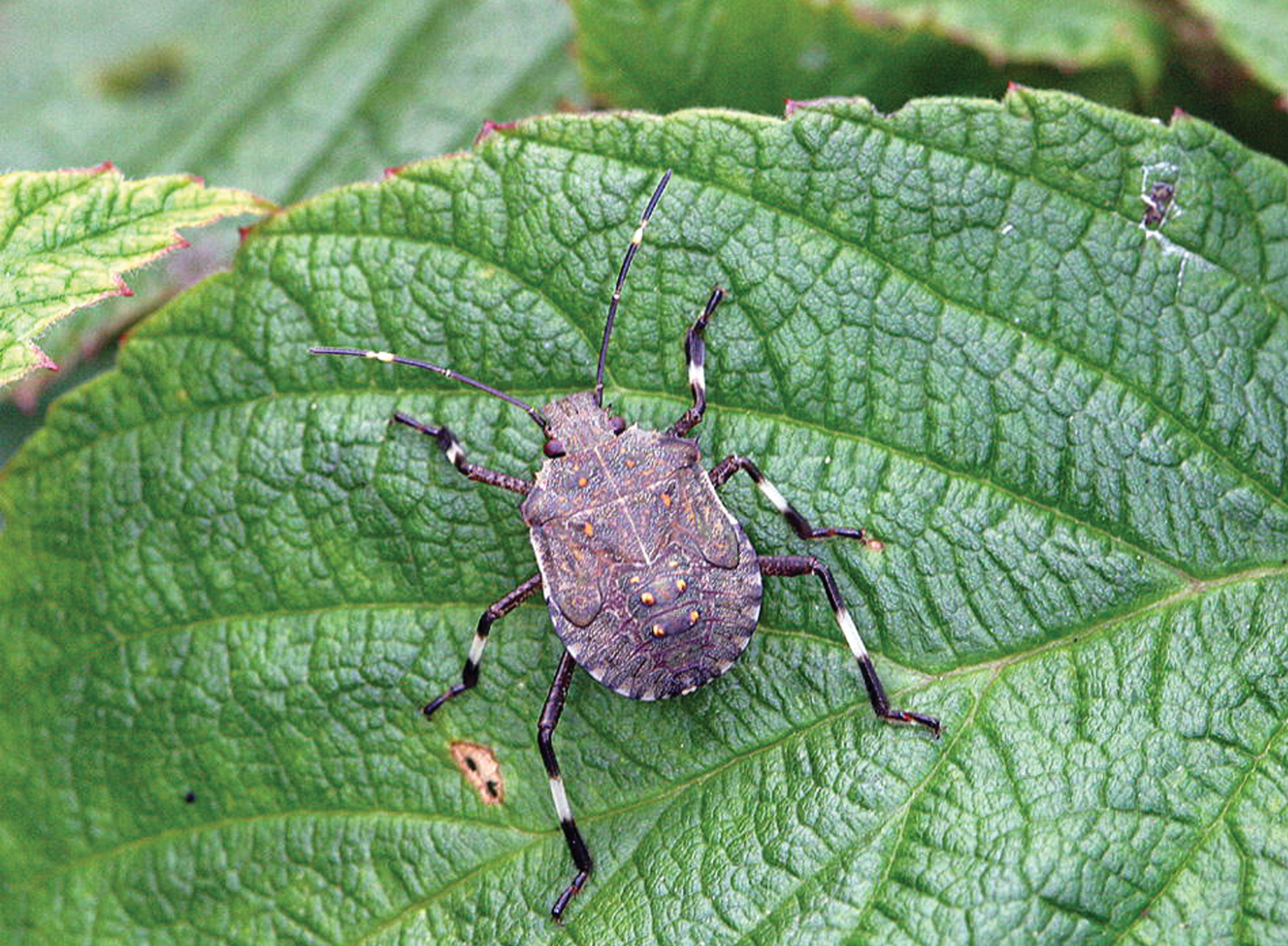
BMSB has five nymph (juvenile) stages that range in size from 2.4 to 12 mm in length with underdeveloped wings. The abdomen is bright orange or red when they hatch but as they mature, they develop a brown colouration similar to the adults.
Eggs are cream or white in colour, 1.6 mm long and shaped like barrels. They are found on the underside of leaves in clusters of 25 to 30.
The adults and larvae can be confused with a number of other brown coloured stink bugs that are present in Australia. The white bands on BMSB’s antennae are a distinguishing feature.
The Department of Agriculture, Fisheries and Forestry (DAFF) has produced a field guide to assist in the identification of this pest. See agriculture.gov.au/biosecurity-trade/pests-diseases-weeds/plant/identify/brown-marmorated-stink-bug for details.
Any unusual stink bugs on your plants or unusual aggregations of stink bugs in or on buildings. Report any unusual sightings to the Exotic Plant Pest Hotline on 1800 084 881.
Adults are strong fliers, a characteristic which allows them to easily spread and establish once within a country. BMSB are hitchhiking pests meaning that they can stowaway on a range of goods and are frequently detected by border staff on imported goods and cargo including machinery, furniture, electrical goods, bricks and cars.
This pest is native to China, Japan, Korea and Taiwan and was introduced to the US in the mid-1990s and Europe in 2007.
BMSB has been formally agreed as an Emergency Plant Pest and is listed in schedule 13 of the EPPRD.Response activities are currently underway to manage BMSB detections in New South Wales (NSW), Queensland (QLD), Victoria (VIC) and Western Australia (WA).
You can protect your farm from brown marmorated stink bug by checking your property frequently for the presence of any new pests. Take care when opening packages from overseas. Make sure you are familiar with the symptoms of common pests so you can tell if you see something different.If you see anything unusual, call the Exotic Plant Pest Hotline on 1800 084 881.
Brown marmorated stink bug (Halyomorpha halys) is a mottle brown coloured, shield shaped stink bug. It is a voracious feeder, affecting about 300 known plants including nuts, grains, fruit, vegetables, nursery stock, and ornamentals.
Originally from eastern Asia, it was introduced to North America in the mid-1990s and more recently to Europe, where it is having a significant impact on agriculture and as a nuisance pest (due to its habit of overwintering in large numbers inside buildings). While feeding the bug’s saliva causes significant damage to plant tissues.
Adults are between 12 and 17 mm long with a mottled brown, shield-shaped body with a slight reddish tinge. Black and white banding around the abdomen periphery is characteristic for BMSB. The underside of the body is pale yellow and can have grey or black markings. The head is rectangular and the pronota (shoulders) are rounded. Antennae in both nymphs and adults have distinctive alternating light and dark bands across the last two segments that look like a single white band.
BMSB has five nymph (juvenile) stages that range in size from 2.4 to 12 mm in length with underdeveloped wings. The abdomen is bright orange or red when they hatch but as they mature, they develop a brown colouration similar to the adults.
Eggs are cream or white in colour, 1.6 mm long and shaped like barrels. They are found on the underside of leaves in clusters of 25 to 30.
The adults and larvae can be confused with a number of other brown coloured stink bugs that are present in Australia. The white bands on BMSB’s antennae are a distinguishing feature.
The Department of Agriculture, Fisheries and Forestry (DAFF) has produced a field guide to assist in the identification of this pest. See agriculture.gov.au/biosecurity-trade/pests-diseases-weeds/plant/identify/brown-marmorated-stink-bug for details.
Any unusual stink bugs on your plants or unusual aggregations of stink bugs in or on buildings. Report any unusual sightings to the Exotic Plant Pest Hotline on 1800 084 881.
Adults are strong fliers, a characteristic which allows them to easily spread and establish once within a country. BMSB are hitchhiking pests meaning that they can stowaway on a range of goods and are frequently detected by border staff on imported goods and cargo including machinery, furniture, electrical goods, bricks and cars.
This pest is native to China, Japan, Korea and Taiwan and was introduced to the US in the mid-1990s and Europe in 2007.
BMSB has been formally agreed as an Emergency Plant Pest and is listed in schedule 13 of the EPPRD.Response activities are currently underway to manage BMSB detections in New South Wales (NSW), Queensland (QLD), Victoria (VIC) and Western Australia (WA).
You can protect your farm from brown marmorated stink bug by checking your property frequently for the presence of any new pests. Take care when opening packages from overseas. Make sure you are familiar with the symptoms of common pests so you can tell if you see something different.If you see anything unusual, call the Exotic Plant Pest Hotline on 1800 084 881.